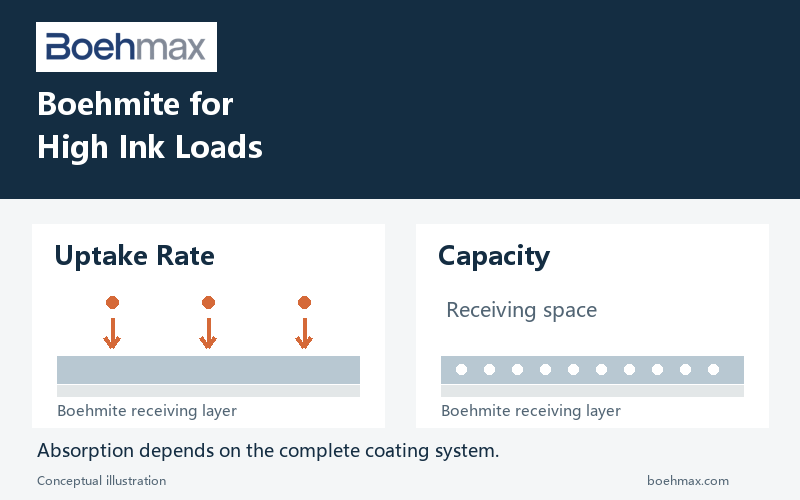
That distinction matters when choosing a material for packaging papers, label stocks or coated board. “Fast drying” can describe a useful product direction, but it should not become a promise that every print will immediately be ready for handling or conversion. The role of boehmite is best understood by connecting its absorption characteristics to the paper product you want to make.
What makes fast-drying boehmite relevant to paper coatings
Boehmax's fast-drying boehmite is designed for ink-receptive coatings on paper and paperboard. Its technical description identifies pore structure and ink-holding behaviour as supporting rapid absorption, stable Color Density and coating strength in suitable systems. This is a material direction for applications where ink reception needs to work with the demands of the printed medium.
Typical uses include coated packaging papers, fast-dry inkjet and label papers, and selected coated paperboards. These applications share a need for a functional receiving surface, but their bases and downstream requirements differ. A material can therefore be relevant to the group without every paper or board being automatically qualified.
When reviewing Boehmax's fast-drying boehmite, relate the product description to the intended substrate and coating. The most useful first question is what the receiving layer needs to do on your medium, rather than how quickly the material is claimed to dry in the abstract.
Absorption and evaporation are different parts of the process
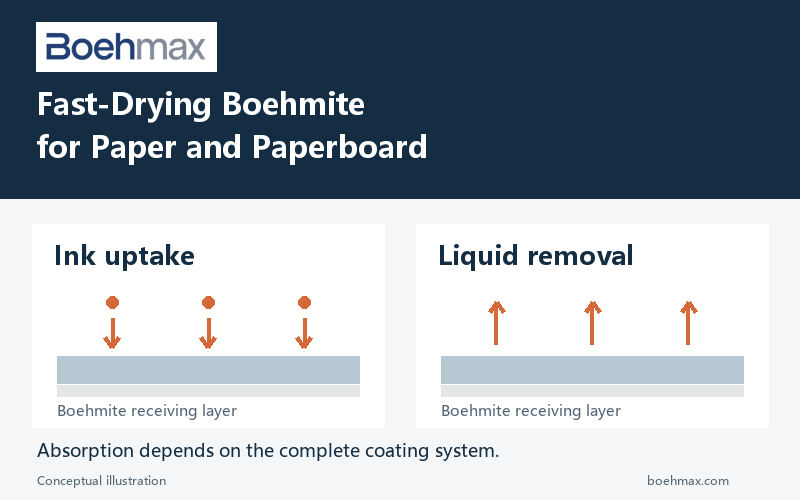
Ink liquid entering a receiving layer is not the same as liquid leaving the printed structure. Absorption concerns uptake into the layer; evaporation concerns liquid removal. A surface can change its handling behaviour while liquid remains within the medium.
Fast-drying boehmite addresses the material contribution to ink reception. Its absorption-related characteristics can support the receiving layer, but the final drying behaviour also depends on the actual ink, substrate, coating amount and process conditions. This is why a fast-absorption material description cannot establish a universal drying time.
For a paper or paperboard developer, the distinction helps keep material selection useful. If the requirement is to reach a particular handling condition, that condition should remain the application objective. The choice of boehmite is one contribution to meeting it, not proof that the objective has already been achieved.
The receiving structure connects boehmite to performance
Boehmite is formulated with other components before it becomes part of a coated surface. The structure formed by that combination governs how the actual layer receives ink. Material selection therefore needs to account for what happens after the powder is incorporated, rather than treating its properties as unchanged proof of finished-coating behaviour.
Published work on porous coating pigments has examined how formulation components affect access to pore space. Ridgway and colleagues' study is listed in the TAPPI PaperCon author directory. Its specific pigment systems do not establish Boehmax product performance, but they illustrate why the formulated receiving structure deserves attention.
For a fast-drying boehmite, this means that the absorption objective and coating integrity belong in the same development discussion. A layer still needs to function as a coating while receiving the ink. It would be inappropriate to prescribe a universal binder adjustment, drying setting or material loading from the product's fast-drying description.
Keep the paper and paperboard boundaries clear
The substrate is part of the receiving system. Coated paper, label paper and coated paperboard are not interchangeable simply because they contain paper fibres. Existing surface treatment, the coating beneath the receiving layer and the intended print use all help define the application.
Boehmax's fast-drying material direction is relevant to selected paper and paperboard systems. A broad range of intended applications does not mean unrestricted compatibility. In particular, suitability for paper-based media is not evidence that the same formulation will adhere to every plastic film.
Fast absorption still needs a usable image
The purpose of a fast-drying ink-receptive material is to support the printed medium, not just to make a liquid observation happen sooner. Color Density, image uniformity and coating strength remain relevant alongside uptake. Improving one aspect does not establish that the entire product requirement has been met.
Boehmax's fast-drying boehmite is intended to support a balance of rapid absorption, ink holding and coating performance. The required balance depends on the application. A paper developed for a particular packaging print may have different priorities from a premium photo medium, even when both need effective ink reception.
This is a reason to choose the material direction from the application rather than assume that fast-drying, high-absorbency and high-gloss grades are interchangeable. Each description helps identify a starting point. It is not a ranking in which one material is universally superior to the others.
Define what the material needs to support
The questions below connect a fast-drying boehmite discussion to the paper or paperboard requirement. They are not a test standard or a set of guaranteed outcomes.
| Application question | Relevance to boehmite selection | Boundary to retain |
|---|---|---|
| What paper or board receives the coating? | Identifies the substrate context for the material | A result on one base does not qualify every other base |
| What handling condition is needed after printing? | Makes the absorption-related objective practical | Absorption does not establish complete evaporation |
| What image quality must be retained? | Keeps Color Density and appearance in the material brief | A fast-looking surface does not prove image quality |
| What must the coating withstand in its intended use? | Connects ink reception with coating integrity | Material positioning is not a finished-product guarantee |
If you already have a smudging problem, the observed symptom still needs to be understood. Smudging alone does not prove that the current material absorbs too slowly. Our guide to slow drying and smudging on inkjet paper addresses that problem description separately. The material question here is whether a fast-drying boehmite direction fits the receiving-layer need once that need is clear.
Discuss the material in the context of your medium
Boehmax Fast-Drying Boehmite for Packaging Inkjet Coatings is designed for paper and paperboard receiving systems. Its intended role is to support rapid absorption and the required coating and image characteristics within a compatible formulation. Final performance depends on the formulation, substrate, coating weight, ink system and processing conditions.
To discuss a fast-drying boehmite application, tell us what paper or board you are coating, the ink system and the handling requirement you want to address. You can begin with that application context without sharing a full proprietary recipe. It gives the material discussion a clear purpose and keeps the proposed solution connected to the medium you actually need to produce.