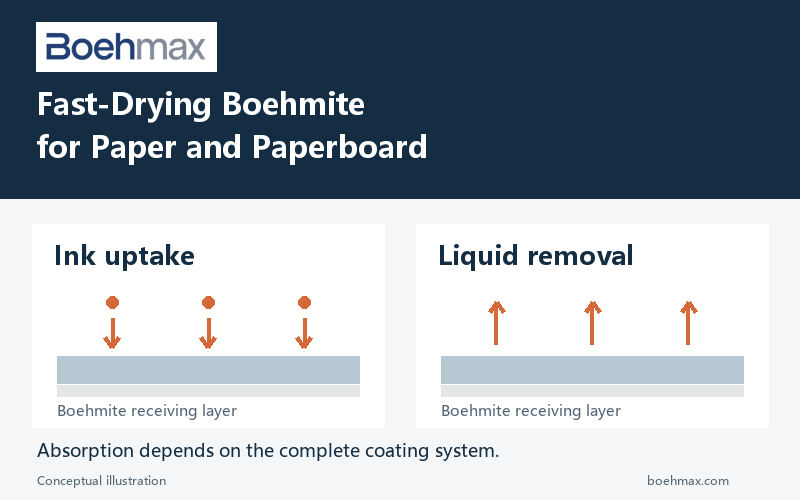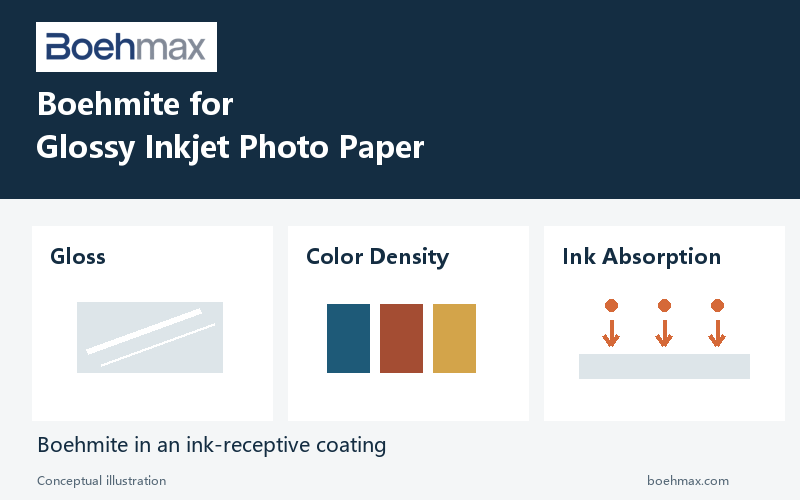
When an inkjet medium needs to accept heavy ink laydown, the receiving layer must do more than look dry after a small drop. It needs to accept the intended liquid load while supporting a usable printed image. High-absorbency boehmite is a material direction worth considering because its pore structure and ink uptake characteristics are intended to support that task.
Choosing it still requires a distinction between the raw material and the coating you make. A powder's surface area or pore-related specification does not tell you how much liquid the finished receiving layer will accept under every printing condition. For high ink loads, the useful question is how the boehmite contributes to an accessible, functional coating structure.
What boehmite contributes to high-ink-load media
Ink-receptive boehmite is used as a functional component of the receiving coating. A high-absorbency grade is designed with liquid uptake and retention as important material characteristics. This makes it relevant to media where substantial ink laydown places demands on the receiving layer.
Boehmax's high-absorbency material is intended for high-ink-load digital inkjet media. Its technical description identifies high specific surface area and an optimized pore structure as supporting rapid uptake and retention, with the aim of contributing to clean drying and consistent Color Density in a suitable coating system.
Those statements describe the product&'s design direction. They do not establish that the material will accept an unlimited amount of ink, eliminate every print defect or work without formulation development. The receiving layer, substrate and actual ink remain part of the application.
For a broader introduction to the material, see our guide to boehmite in ink-receptive coatings. Here, the focus is the link between high ink loads and the pore-related questions that matter when selecting a grade.
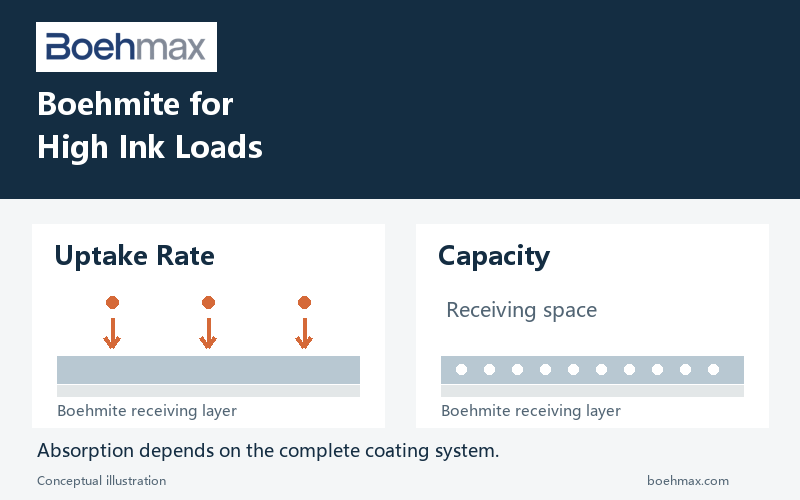
Absorption speed and capacity answer different questions
A high-ink-load application needs a receiving layer that can take in liquid at a useful rate and accommodate the relevant load. Speed describes how quickly uptake occurs. Capacity concerns how much liquid the structure can receive under the stated conditions. Neither description should silently stand in for the other.
This distinction helps explain why “fast absorption” is not a complete material selection brief. A small liquid observation may show that uptake begins readily, but it does not establish the behaviour of a heavily printed area. Equally, a material's capacity-related information does not establish the time required for a particular print to reach its handling condition.
For boehmite selection, describe the demand before treating an absorption statement as an answer. Is the challenge associated with heavily covered areas, a particular medium or a change in the print design? The supplier can then relate the high-absorbency material direction to the receiving-layer requirement, rather than assuming every application called “high ink load” is the same.
Why the finished pore structure matters
Boehmite enters a formulation with other components and is then applied and dried to form a receiving layer. The structure available to ink in that layer depends on how the components come together. It cannot be read directly from a single powder property.
Research by Ridgway and colleagues on specific porous coating pigments examined how binders and additives affected access to pore space. That work provides a useful reason to consider the formulated structure, rather than treating raw pigment porosity as unchanged after coating. It is not a study of Boehmax boehmite and does not provide a universal formulation rule. The paper is listed under its full title in the TAPPI PaperCon author directory.
For a high-absorbency boehmite, the practical implication is to keep material information connected to the coating's intended function. Pore-related specifications help describe the candidate. The actual receiving layer determines which pathways and spaces are available to the liquid under the application conditions.
This is also why a comparison based only on “more pores” is incomplete. The liquid must be able to enter and move through a useful structure. A description of total pore space alone does not show how that structure behaves after the material is dispersed, formulated and coated.
Surface area is useful information, not a performance ranking
High specific surface area is part of the technical description of Boehmax's high-absorbency boehmite. It is relevant material information, but choosing the largest value without considering the application turns a specification into a claim it cannot support on its own.
Keep liquid uptake connected to the printed image
The purpose of high absorption is to support a usable print, not to win a water-uptake comparison in isolation. The ink contains a liquid vehicle and colourant, and the image needs to retain the required appearance after printing. Surface liquid, edge definition, uniformity and Color Density describe different aspects of that outcome.
Boehmax's high-absorbency boehmite is intended to support uptake and retention in the receiving coating. Whether that produces the desired result with a particular ink must be assessed in that system. A water observation can inform development, but it cannot establish compatibility with every formulated ink.
Heavy coverage also needs to be described honestly. A printed region with a demanding ink load is not interchangeable with a lightly printed one, and changing print settings can change the demand on the medium. None of this makes the material information unhelpful; it explains why the information needs an application context.
Connect each material question to the receiving layer
The following framework can help a media developer organise a discussion about high-absorbency boehmite. It contains no test results or suggested performance thresholds.
| Material question | Why it matters for high ink loads | What the answer cannot establish alone |
|---|---|---|
| Is the grade intended for high-absorbency coatings? | Connects the material direction to the application demand | Compatibility with every ink and substrate |
| What pore-related information is available? | Helps describe the structure of the candidate material | The accessible capacity of the finished coating |
| How is uptake distinguished from capacity? | Keeps rate and liquid-load questions separate | A universal drying or handling time |
| How does the material fit the intended medium? | Links the selection to the receiving-layer design | Guaranteed adhesion, image quality or durability |
Where Boehmax's high-absorbency boehmite fits
Boehmax High-Absorbency Boehmite is designed for ink-receptive coating systems used in high-ink-load digital media. Its intended applications include selected advertising media, high-absorbency photo papers and related media. The relevant question is whether this absorption-focused direction matches the demands of your receiving layer.
Final performance depends on the complete formulation, coating weight, substrate, ink system and processing conditions. In particular, a material's high-absorbency positioning should not be read as a guarantee of adhesion on an untested film or as a claim that every heavy-coverage image will be free of defects.
To discuss high-absorbency boehmite with Boehmax, tell us the medium, the ink system and where the ink-load demand arises. With that context, the conversation can focus on the material's intended role and the application questions that still need to be answered.