Introduction: Why Ink Receptive Layers Decide Print Quality
In modern inkjet printing, the coating layer often determines whether a substrate can deliver high color density, sharp edges, fast drying, and stable printing performance—especially under high ink load and high-speed production.
For packaging paperboard, photo media, medical imaging prints, and many functional inkjet workflows, the challenge is always the same: how to control ink absorption and ink fixation at the same time. Absorb too slowly and you get smearing; absorb too fast and you lose gloss, color density, or image definition.
This is where boehmite-based ink-receptive materials are widely used as a functional component in ink receptive coatings.
1. What Is Boehmite?
Boehmite is an aluminum oxyhydroxide material (often used in high-performance dispersions and coatings). In printing media applications, it is valued not simply as a “filler,” but as a functional coating component that helps build a controlled porous structure for ink management.
In ink-receptive layers, boehmite can support:
• Controlled ink absorption (capillary uptake and transport)
• Ink fixation (reducing lateral ink spread)
• Coating stability (improving process consistency when properly dispersed)
In practical terms, boehmite is often selected when coating formulators need a balance between absorption capacity, print definition, and batch-to-batch consistency.
2. Why Boehmite Works in Ink-Receptive Coatings
Inkjet coatings need to perform multiple functions at once:
1) accept ink quickly,
2) hold colorants near the surface,
3) avoid feathering and coalescence,
4) keep the coating stable and processable.
Boehmite contributes to these goals through a combination of surface chemistry and micro-structure control.
2.1 Controlled Porosity for Ink Uptake
A well-designed ink receptive layer typically relies on a porous network that pulls ink into the coating while minimizing uncontrolled lateral spreading. Boehmite can help form a porous structure where ink absorption is fast but controllable—supporting both drying speed and print definition.
2.2 Better Ink Fixation for Color Density and Sharpness
High color density and sharp edges require that pigments/dyes remain in the right zone—often close to the surface—while the solvent/water is managed efficiently. In many formulations, boehmite helps improve ink fixation behavior, supporting:
• higher color density
• improved sharpness
• reduced smearing
2.3 Process Stability and Consistency
Industrial coating lines demand stable slurry rheology, coatability, and reliable results across batches. When properly engineered for dispersion and compatibility, boehmite can contribute to:
• stable coating preparation
• consistent coating performance
• reliable production runs
This is particularly important for applications where print consistency and repeatability matter more than “best-case” lab results.
3. Where Boehmite Is Commonly Used in Inkjet Media
Boehmite-based ink receptive materials are used across multiple media types, including:
Packaging Printing Substrates
Packaging paperboard and coated papers often face high-speed printing requirements. Key objectives include:
• fast drying
• reduced smearing
• stable performance under production conditions
Digital Inkjet Printing Media
In digital production printing, print quality is often limited by coating design. Boehmite can support:
• ink absorption control
• line sharpness and detail rendering
• process stability for coating/printing
Medical Imaging and Diagnostic Prints
Medical imaging media typically requires:
• stable grayscale reproduction
• controlled ink absorption
• batch consistency for repeat results
Photo Imaging and High-Gloss Media
High-gloss photo paper and premium imaging media emphasize:
• gloss retention
• high color density
• reduced artifacts such as mottling or coalescence
Fine Art & Canvas (Giclée Printing)
Fine art printing needs both performance and aesthetics:
• rich colors and tonal smoothness
• fine detail reproduction
• controlled ink behavior on specialty substrates
4. Boehmite vs. Silica in Ink-Receptive Coatings (Practical View)
Silica is also widely used in ink receptive layers. The choice between boehmite and silica is not simply “which is better,” but which is more suitable for your target KPI and coating structure.
In many cases:
• Silica may be selected for certain porosity and absorption behaviors
• Boehmite may be selected when formulators prioritize ink fixation, sharpness, and stable performance under specific coating systems
Some coating systems also use blended structures where boehmite and silica complement each other.
A practical recommendation: define your top KPIs first (drying speed, color density, gloss, sharpness, process robustness), then evaluate materials based on how they support those KPIs in your coating architecture.
5. Key Considerations When Selecting Boehmite for Ink Receptive Coatings
When evaluating boehmite materials for ink receptive layers, buyers and formulators typically look at:
• Dispersibility and slurry stability
• Particle size distribution (affects coating micro-structure and print behavior)
• Surface area (influences absorption and interaction with ink components)
• Compatibility with binder systems and ink chemistry
• Batch consistency for stable production performance
Selection should always be based on the target application (packaging, photo media, medical imaging, industrial inkjet) and the required KPIs.
Conclusion: Boehmite as a Functional Component, Not Just a Raw Material
In inkjet receptive coatings, boehmite is best understood as a functional component that helps coating formulators balance:
• ink absorption control
• ink fixation for higher color density and sharpness
• stability and production consistency
If you are developing or optimizing ink receptive layers for packaging printing, digital inkjet media, imaging media, or functional coatings, boehmite can be a highly effective material option—especially when aligned with your coating structure and performance targets.
Next Step: Discuss Your Application and KPI Targets
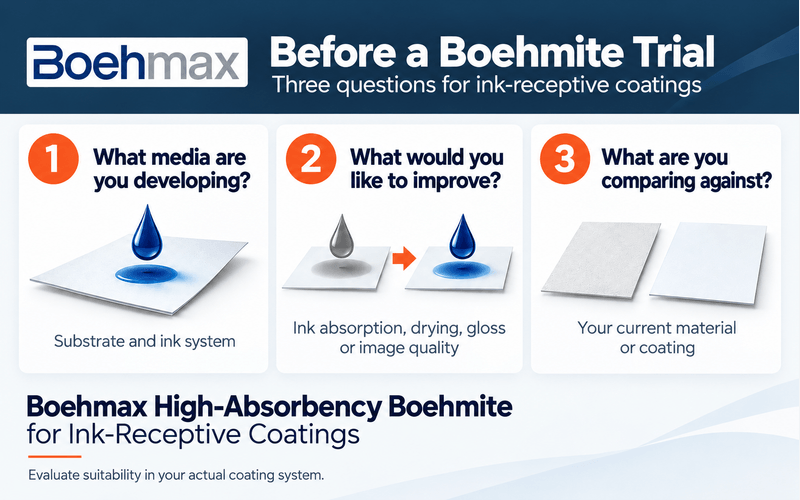
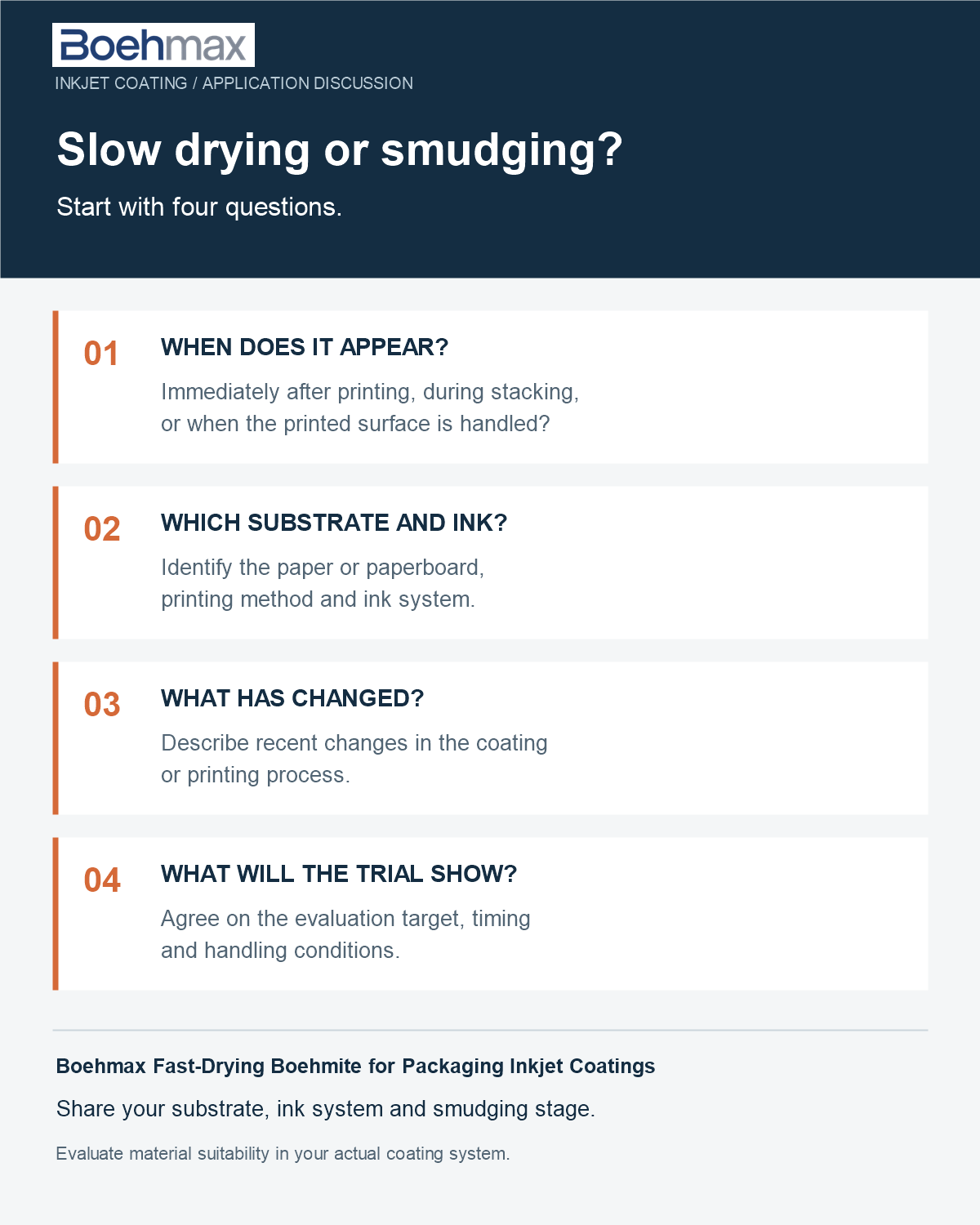
If you are working on an ink receptive coating project and want to match materials to your performance KPIs (drying speed, color density, sharpness, gloss, batch consistency), we can support evaluation and sample testing.
Contact us → to discuss your substrate type, ink system, coating structure, and target printing performance.