When you choose boehmite for glossy inkjet photo paper, the aim is to build a receiving layer that supports both the surface appearance and the printed image. High absorption alone is not the whole requirement. A photo medium also needs the gloss, Color Density and detail that make an image look right in its intended use.
A high-gloss imaging grade of boehmite is a relevant material direction because its particle and pore characteristics are selected for this combination of needs. It should still be assessed in the coating, paper and ink system you plan to use. The material provides a starting point for development; it does not determine the finished paper's performance on its own.
Why boehmite belongs in the receiving layer discussion
Boehmite is an aluminum oxyhydroxide used as a functional material in ink-receptive coatings. In this application, its role goes beyond adding mineral solids. It contributes to a structure that receives ink liquid while supporting the surface and image characteristics required by the medium.
For glossy photo paper, those functions must work together. A coating that accepts liquid but gives an unsuitable surface appearance has not met the product brief. Equally, an attractive unprinted surface does not establish that the same coating will produce the desired printed image. This is why the choice of boehmite should begin with the intended imaging product, rather than a search for the largest absorption-related number on a data sheet.
Our introduction to boehmite in ink-receptive coatings explains the broader material role. For photo paper development, the more specific question is which material characteristics support the balance your medium needs.
Start with the image, then identify the material priorities
A premium photo paper and a high-ink-load advertising medium may both need an absorbent receiving layer, but they do not necessarily place the same emphasis on every material characteristic. For photo paper, background appearance, the appearance of printed areas and reproduction of fine image detail can all influence the choice.
Boehmax's high-gloss imaging material is described in its technical data sheet as having fine particle size and a balanced pore structure that support surface gloss, Color Density and image clarity while maintaining controlled ink absorption. These are the reasons to consider this material direction for premium imaging media. They are not a statement that every formulation containing the material will achieve the same result.
Treat gloss and ink absorption as connected requirements
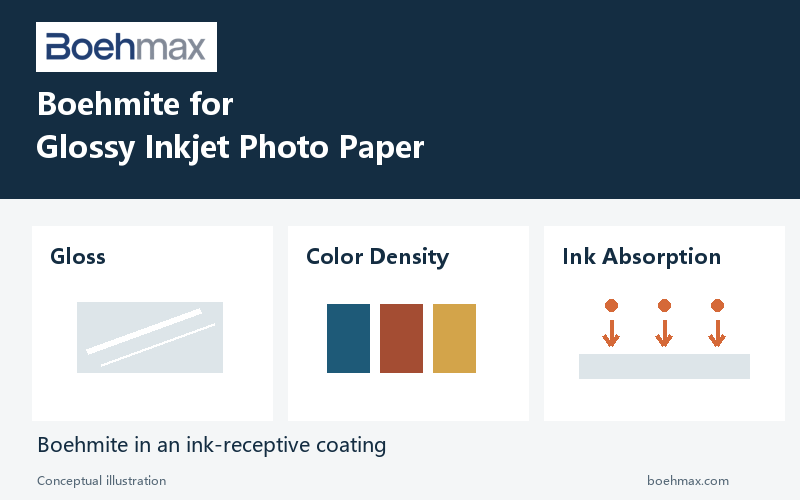
The receiving layer has a surface that the viewer sees and a structure through which ink liquid can move. Choosing boehmite for glossy inkjet photo paper means considering both. Neither the word “porous” nor a fine particle-size description is enough to predict the final balance.
The structure that develops when boehmite is formulated and coated is not identical to the powder described in isolation. Other coating components, the amount applied and the drying process remain part of that structure. A material characteristic can therefore be relevant to selection without providing a direct equation for the finished paper's gloss or absorption.
For the same reason, there is no sound basis for assuming that the highest-absorbency grade is automatically the best high-gloss grade. A high-absorbency material may be appropriate when the main challenge is heavy ink laydown. A high-gloss imaging material addresses an application in which optical performance is also a central requirement. The choice should follow that distinction, rather than a general ranking of which powder is “better.”
Color Density keeps the choice connected to the print
Gloss describes one aspect of the surface. Color Density concerns the printed image and should not be replaced by a judgement that the sheet looks shiny. For an imaging-grade boehmite, supporting the intended image includes considering ink reception together with the resulting colour and detail.
An early study by Kang and Lee used a boehmite-type alumina sol with a binder on resin-coated paper and examined printed-image properties under different formulation conditions. It provides a documented example of boehmite being used as part of an imaging coating system. It does not demonstrate the performance of Boehmax materials or establish a recipe for other paper structures. The IS&T article page identifies the original study and its scope.
Keep the paper structure in the selection
The same boehmite is not being asked to do exactly the same job on every paper. Resin-coated photo paper, a non-RC base and a pre-coated paper present different starting surfaces. A favourable result on one does not qualify the material-and-formulation combination on the others.
This matters when moving from an existing matte product towards a glossy one. The change is not simply a request for a more absorbent raw material. The final receiving surface, the base beneath it and the intended print all need to be considered together. Material selection can help address the brief, but it cannot remove the influence of the base paper.
Describe the base and any existing coating when discussing a high-gloss boehmite. You do not need to begin by sharing a proprietary recipe. Knowing the type of medium, the intended finish and the ink system is enough to make the first discussion more specific than “we need better gloss.”
Match the selection question to the material information
The following guide links the application brief to the questions worth asking about boehmite. It is a selection framework, not a set of measured results or acceptance limits.
| Your application priority | What to discuss about boehmite | What still belongs to the complete system |
|---|---|---|
| Glossy photographic appearance | A material direction intended for high-gloss imaging coatings | Base paper, coating surface and processing conditions |
| Color Density and fine detail | The material's intended imaging role alongside ink reception | Specific ink, printed image and measurement conditions |
| Liquid uptake under the intended print load | Pore-related material characteristics and the absorption objective | The accessible receiving structure after formulation and coating |
| A change of paper structure | Whether the proposed material direction suits the new application brief | The influence of the base and any pre-coating |
Where Boehmax's high-gloss imaging boehmite fits
Boehmax High-Gloss Imaging Grade Boehmite is designed for ink-receptive coatings used in premium imaging media. For glossy inkjet photo paper, its relevance lies in the combination of surface gloss, Color Density, image clarity and controlled ink absorption described in the material's intended role.
The next step is to connect that role to your paper. Final performance depends on the formulation, coating weight, substrate, ink system and processing conditions. A product description helps identify a candidate; the actual medium establishes whether that candidate meets the requirement.
If you are developing glossy inkjet photo paper, discuss your boehmite requirements with Boehmax. Tell us the paper structure, the finish you want and the image characteristic you need to improve. That gives us a clear basis for discussing the material direction without assuming that one grade or one powder property can answer every imaging need.