Moving from a matte inkjet coating to a glossy one changes the job you are asking the receiving layer to do. Boehmite can be a relevant material for that change because high-gloss imaging grades are designed to combine surface appearance with controlled ink absorption. But selecting the powder is only part of developing the new medium. A formulation that works for your matte product is a useful reference, not a confirmed recipe for a glossy version.
The practical starting point is to identify what must change and what must remain acceptable. You may want a different surface finish while retaining image detail, Color Density and reliable handling after printing. Those requirements define the role of the boehmite in the new coating. They also help you avoid treating the project as a simple exchange of one mineral for another.
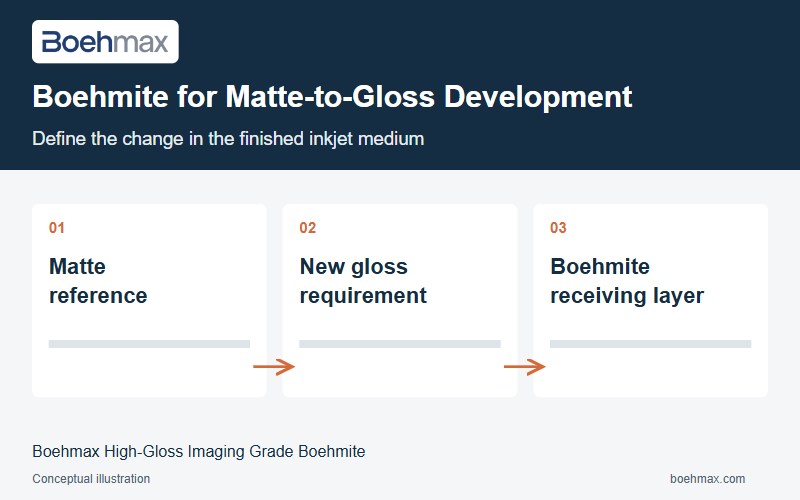
Keep the successful matte product as a reference
An existing matte product gives you useful information: the paper you can coat, the inks you intend to receive and the image characteristics your customers already accept. Keep that information attached to the development brief. It is more informative than asking for a powder that produces a glossy surface without explaining the medium.
Separate the new appearance requirement from the properties you want to retain. For example, the development question might be whether a boehmite-based receiving layer can provide the intended glossy finish on the same paper while keeping printed detail acceptable. That is a clearer question than asking whether a high-gloss grade is simply better than the current material.
Select boehmite for its role in the finished layer
In this application, boehmite is part of the ink-receptive coating structure. The material choice should connect to the finish and image you want from that structure. A high-gloss imaging grade is relevant when surface gloss, Color Density, image clarity and controlled absorption need to be considered together.
That does not make a grade description a prediction of your finished paper. Fine particle characteristics and a suitable pore structure are material information; your formulation, coating weight, substrate, ink and processing conditions determine how the candidate is used. The same distinction applies when comparing a proposed boehmite with a material already present in your matte coating.
Ask what evidence supports the proposed material direction, rather than assuming that a product labelled high gloss can be substituted at the existing loading. Useful evidence identifies the receiving layer and intended imaging application. A result on an unspecified coated sheet gives you much less information about the change you are considering.
Our introduction to boehmite in ink-receptive coatings explains the broader material role. For matte-to-gloss development, the next question is how that role fits the new surface requirement on your particular medium.
A glossy boehmite layer is more than a powder choice
An early patent on pseudo-boehmite-coated paper (PDF) describes forming the receiving surface against a smooth support and transferring it to paper. It also describes smoothing a coated paper surface. These are specific manufacturing examples, not a general recipe for every boehmite grade. Their relevance here is that the reported glossy surface belongs to a material-and-process combination, rather than to the powder name alone.
For your development work, this suggests a useful distinction: selecting a candidate boehmite and establishing how the receiving surface will be formed are connected decisions. A published result obtained by one surface-forming route should not be presented as the expected result of a different coating route. We are not recommending that you reproduce the patent process.
If you intend to retain your current coating method, make that constraint explicit when discussing materials. It helps distinguish a candidate suited to investigation within your existing process from an example whose appearance depends on a different manufacturing approach. This is especially useful when a reference sample looks attractive but its production history is unclear.
Define the change before comparing samples
The following questions keep a matte-to-gloss discussion focused on the material decision. They are not a formulation or a set of test limits.
| Development question | Why it matters for boehmite selection |
|---|---|
| Will the paper and any existing surface coating remain the same? | The proposed receiving layer needs to be considered on that actual base. |
| Which appearance is changing: unprinted surface, printed image, or both? | A glossy blank sheet alone does not establish the intended printed result. |
| Which image properties from the matte product must be retained? | The material choice must serve the product brief beyond surface finish. |
| Will the same ink and printing conditions be used? | Changing the ink at the same time makes a simple material comparison harder to interpret. |
| Is the reference coating made by a comparable route? | A different route may limit what its result tells you about your candidate. |
Use a clear description of the desired finish, supported by an agreed reference where available. If a gloss measurement is part of the brief, retain its measurement conditions with the result. A number without those conditions does not give a supplier enough context to compare the new coating with your target.
Read the printed result as part of the new product
For a glossy imaging medium, it is useful to distinguish the appearance of the unprinted coating from the appearance after printing. Consider the image content that matters to the application: fine detail, solid coloured areas, or transitions between colours. This keeps Color Density and image clarity connected to the reason you selected the boehmite.
It also helps separate observations from explanations. If the surface looks glossier but the printed result is not acceptable, that is a finding about the complete candidate medium. It does not, by itself, identify the boehmite as the cause or prove that the material cannot be useful in another formulation. Describe what changed before deciding why it changed.
Avoid turning a successful small sample into a broad production claim. Keep the paper, ink and coating conditions attached to the result so that the next decision is based on the same application. The useful output is a more specific view of the candidate's suitability, not a declaration that one powder converts all matte coatings into glossy ones.
Discuss the new medium with Boehmax
Boehmax High-Gloss Imaging Grade Boehmite is designed for ink-receptive coatings in premium imaging media. Its intended role combines surface gloss, Color Density and image clarity with controlled ink absorption. That makes it a material direction to discuss when developing a glossy imaging product, with suitability established in the actual coating system.
You do not need to disclose a confidential formulation to begin that conversation. Describe the current medium, the finish you want to achieve, the ink system and the performance you need to retain. State whether the paper and coating method are fixed constraints. These details make the material discussion useful before a powder comparison becomes a collection of unrelated numbers.
If you are moving from matte to glossy inkjet media, discuss your boehmite requirements with Boehmax. Start with the change you want in the finished medium, and we can discuss the relevant material direction without assuming that a grade name guarantees the final result.