A boehmite-based ink-receptive coating may be a candidate for a medium printed with dye or pigment inks, but the material name does not establish compatibility with both. The useful question is whether the finished receiving layer works with the particular ink and imaging application you intend to use. Evidence for one combination should remain attached to that combination.
For a coating developer, this changes how a supplier discussion begins. Instead of asking whether boehmite is universally dye-compatible or pigment-compatible, describe the medium, identify the ink system and explain the result you need. That creates a material-selection question which can be answered with relevant information rather than a broad label.
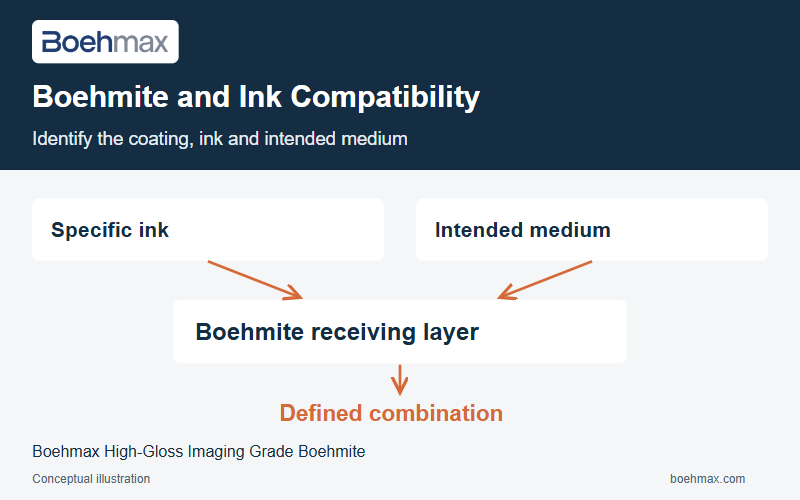
Compatibility belongs to a defined coating and ink combination
An ink-receptive boehmite is selected for its role in a coating. Its material characteristics do not describe every component of the ink that will meet that coating, or every condition under which the finished medium will be printed. A product data sheet is therefore a starting point for selection, rather than a list of all compatible inks.
This does not mean that every discussion has to begin again from nothing. An existing result can be useful when its scope is clear. If the same medium, receiving layer and ink were used, the result is directly relevant to that combination. If the ink changes, the earlier result becomes a reference for a new compatibility question.
Keep three statements separate: the boehmite is intended for imaging coatings; a particular formulation has been used with an identified ink; and the finished medium has met your application's requirements. Each statement answers a different question. The first can help select a candidate, but it does not automatically establish the other two.
Dye and pigment labels do not identify the whole ink
Dye inks use dissolved colourants, while pigment inks contain dispersed colourant particles. That distinction is useful, but it is not a complete description of an ink formulation. For a boehmite receiving layer, the actual ink remains part of the application being assessed. The words dye or pigment should help define the discussion, not end it.
There is a concrete example of this limitation in a patent describing aluminium oxyhydroxide-containing primers for aqueous pigment inks. It states that the coating composition must be adapted to the specific ink. Its examples use defined coatings and inks. We cite this as evidence of a formulation-specific approach, not as proof that the described primer is equivalent to Boehmax's high-gloss material or to your receiving layer.
The practical implication is to ask which ink was used when someone reports compatibility. A result with one pigment ink should not silently become a claim for every pigment ink. Nor does a dye-ink result establish pigment-ink performance simply because both inks are water-based.
Keep liquid reception and image quality in the same discussion
For imaging media, receiving the liquid is important, but it is not the complete product requirement. The printed result also needs to meet the intended appearance and use. This is where boehmite selection remains connected to color density, image clarity and the surface characteristics of the finished medium.
If a sample accepts the applied ink but produces an unacceptable image, describe the observation precisely. Is the concern a colour boundary, fine detail, surface appearance or handling after printing? These observations help define what compatibility means for your product. They do not, on their own, identify a particular material mechanism or prove that changing the boehmite will solve the issue.
Conversely, a good-looking print immediately after printing does not answer every handling question. State the condition in which the medium needs to be used or processed. Keep that requirement separate from the initial visual impression, so that a favourable image is not interpreted as evidence for an unexamined downstream use.
Ask what a reported result actually covers
Published boehmite coating examples can help establish that an application has been investigated. They must still be read at the level of the disclosed system. A general description may mention several ink categories while the reported tests cover a more specific case.
For example, a patent on inkjet-printable film discusses dye and pigment inks, while its stated print-performance evaluation uses aqueous pigment inks. That distinction matters when interpreting the evidence. It does not provide a universal head-to-head validation of both ink categories on every boehmite coating.
When reviewing a reference, look for the actual substrate, receiving-layer construction, ink identification and evaluated result. If one of these is missing, keep the conclusion correspondingly narrow. You can still use the reference to frame a discussion without presenting it as a finished qualification for your medium.
Make a compatibility question specific enough to answer
The following distinctions are useful when you are discussing an ink-receptive boehmite with a supplier. They organise the information; they do not prescribe a formulation or a universal test method.
| Question | Information that makes the answer useful |
|---|---|
| Which ink will meet the coating? | The actual ink identity or a non-confidential description, not only the dye/pigment category. |
| Which receiving layer is being discussed? | The intended boehmite role and whether the coating is the same as the reported reference. |
| What does an acceptable image look like? | The application priorities, such as color density, detail and surface appearance. |
| When must the printed medium be handled? | The required state after printing, rather than an undefined claim of fast drying. |
| What supports the compatibility statement? | A clearly identified combination and result, with its limits retained. |
If you are comparing two ink systems, keep the question about the receiving layer consistent. A comparison becomes difficult to interpret when the paper, coating construction and printing conditions all change without being identified. You may be comparing two finished media rather than learning how one candidate coating responds to different inks.
Use the material description for the decision it can support
Boehmax High-Gloss Imaging Grade Boehmite is designed for ink-receptive coatings in premium imaging media. Its intended role includes surface gloss, color density, image clarity and controlled ink absorption. These characteristics provide a basis for discussing a candidate for the imaging application.
They are not a statement that all dye and pigment inks have been qualified. Final coating performance depends on the complete formulation, coating weight, substrate, ink system and processing conditions. Retaining that context helps you distinguish a relevant material choice from a claim that would require additional application evidence.
A useful enquiry can be brief: identify the medium, say whether you are developing for a specific dye ink, pigment ink or both, and describe the image or handling requirement that matters most. If there is an existing result, explain which combination produced it. Confidential ink or coating recipes are not required to open the discussion.
To explore a material direction, discuss your ink-receptive boehmite application with Boehmax. The aim is to connect the candidate material to the coating and ink you actually plan to use, with a clear understanding of what is established and what still needs application-specific evaluation.