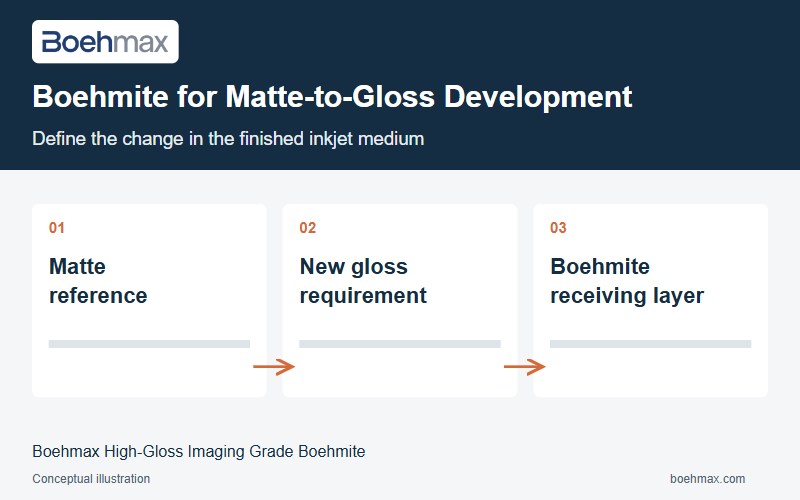
A result from a boehmite ink-receptive coating on paper can help you choose a material direction for PET, but it does not qualify the PET medium. What you can carry forward is the reason for considering the material and a clearly described reference system. The finished coating's appearance, image quality and suitability remain questions for the new construction.
The reverse is equally important: a successful film example does not establish performance on an unspecified paper. For a coating developer, the useful comparison begins with what is actually beneath the boehmite receiving layer. Paper and PET are useful names for the base materials, but they do not fully describe the surfaces being coated.
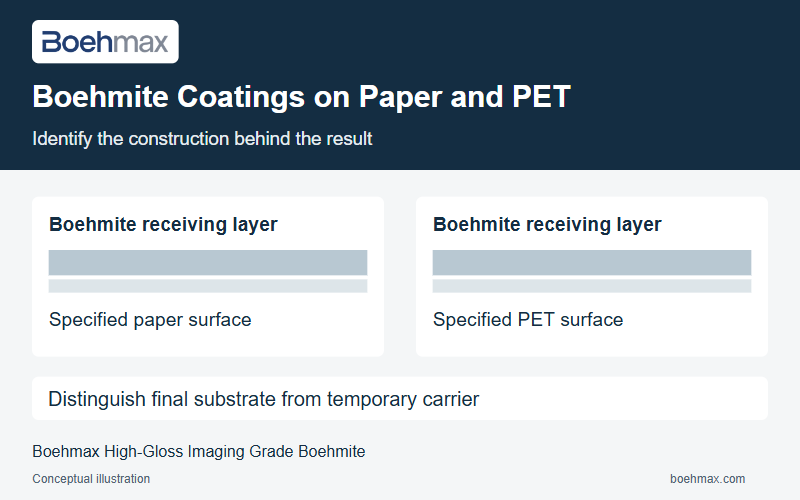
Describe the surface that meets the boehmite layer
A paper reference may involve an existing surface coating or a resin-coated base. A film reference may use a treated or precoated PET surface. Keep those details with the result. Otherwise, a description such as boehmite on paper or boehmite on PET can conceal an important difference between two constructions.
This is a practical evidence question before it becomes a formulation question. If your candidate material was assessed on one construction, you need to know that construction to decide how useful the result is for another. The material name alone cannot tell you which parts of the evidence still apply.
For boehmite in ink-receptive coatings, the receiving layer is the relevant context. Identify its position in the medium: what lies directly below it, what is exposed to the ink and whether the reference includes any additional surface layer. A short description of these features is more informative than simply labelling the sample paper or film.
Read a PET example as a construction, not a material endorsement
One published patent example of a boehmite-coated film uses a BOPET film with a polyacrylate surface coating, followed by surface treatment and a boehmite-containing receiving layer. The example is therefore about a defined film construction. It should not be reduced to a claim that boehmite alone makes any PET surface suitable for inkjet printing.
That observation does not require you to reproduce the disclosed process. It tells you how to read the evidence: the surface preparation and layer arrangement are part of the example's scope. Removing them from a summary would make the result sound more general than the underlying information allows.
For your own enquiry, explain whether the PET is supplied with a coating or treatment and whether that surface is the one you intend to coat. If the information is unavailable, leave it as an open condition. It is better to identify that gap than to infer that a named film is equivalent to the reference construction.
A reference to PET may describe a temporary carrier
There is another reason to read the full process description. A material mentioned in a coating publication is not always the final printing substrate. In an early pseudo-boehmite paper-coating patent, PET is used as a support from which the coating is transferred to paper and then removed. The finished medium in that example is paper, not a boehmite-coated PET printing film.
This distinction is useful when reviewing search results or a short technical summary. A document containing both boehmite and PET may be relevant to surface formation, yet provide no qualification of a retained PET base. Check what remains in the finished article before using the example to support a material choice. The source and its exact role are identified in the EPO patent document (PDF).
The same reading discipline applies to paper evidence. A result described as paper-based should not automatically be taken as evidence for every uncoated, precoated or resin-coated paper. Carry over the construction details alongside the result so that the next application question stays visible.
Separate useful material information from unproven transfer
The following distinctions help decide what a reference can contribute to a new boehmite application. They are an evidence-reading guide, not a ranking of paper and PET.
| What the reference tells you | What you can use it for | What it does not establish |
|---|---|---|
| Boehmite is used in an identified receiving layer | Understanding a material direction for that type of coating | Qualification of every grade or formulation |
| A result is reported on a stated paper construction | Assessing its relevance to a similar development brief | The same result on an unspecified PET surface |
| The film includes a precoat or treatment | Recognising the scope of the film example | That the layer preparation can be omitted |
| PET is removed during manufacture | Understanding its role as a temporary carrier | Performance of PET as the final printing medium |
| The final medium is tested with an identified ink | Interpreting that reported imaging result | Compatibility with all other inks or constructions |
The material description can still be useful across applications. For example, a grade intended for high-gloss imaging coatings provides a reason to consider it for a relevant imaging brief. What should not travel without evidence is the finished sample's result. Keep candidate selection separate from qualification of the new medium.
Keep the new application question visible
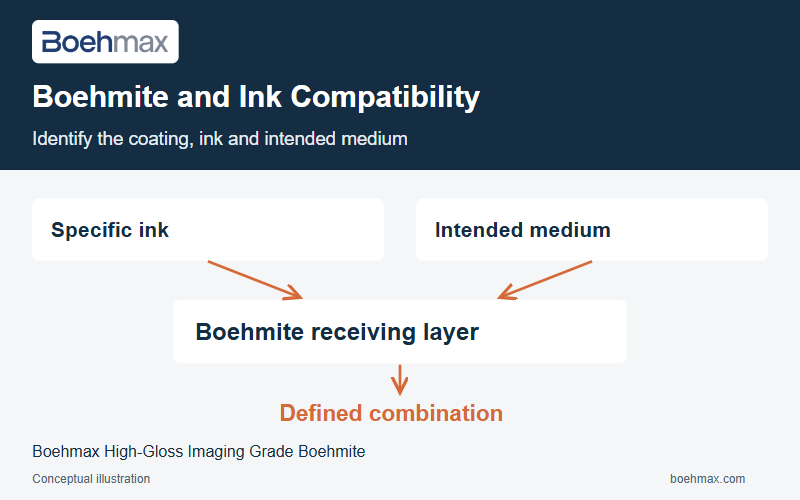
If you are moving a development programme from paper to PET, describe the intended finished product before comparing powders. Is the imaging surface expected to have a particular appearance? Which ink will be used? What must the printed medium do after printing? These questions define why you are considering the boehmite and which part of the paper reference is useful.
Then identify the differences between the reference and the proposed construction. You do not need to turn the initial enquiry into a detailed process specification. A clear description of the base, any known precoat and the intended receiving layer is enough to prevent a paper result from being treated as a film guarantee.
When a comparison gives a different outcome, keep the observation at the level it supports. An image-quality difference between two finished media does not, by itself, isolate the boehmite as the cause. If the base, coating construction or ink changed, the result concerns those different systems. That context is essential before deciding whether the material direction should change.
You can use a paper example to discuss the role of an ink-receptive boehmite while leaving PET-specific suitability open. The value lies in knowing which question the reference answers.
Discuss boehmite with the complete medium in view
Boehmax High-Gloss Imaging Grade Boehmite is designed for premium imaging-media coatings, with surface gloss, color density, image clarity and controlled absorption as its intended material role. This provides a starting point for a relevant application discussion. It is not a claim that every paper or PET construction has already been qualified.
For a useful first conversation, describe the final printing substrate and the surface that will meet the boehmite layer. Include the ink system and the imaging requirement you want to achieve. If you are using a published or existing sample as a reference, identify its construction and the result you want to carry forward. Confidential formulation details are not necessary to establish these boundaries.
If you are developing a new paper or PET imaging medium, discuss your boehmite application with Boehmax. A clearly defined receiving layer and end use allow the material discussion to begin with relevant evidence, rather than an assumption that a successful result transfers unchanged between substrates.