When you’re considering a new material for an ink-receptive coating, a technical data sheet is often the first document you read. A certificate of analysis may follow when you review a particular batch.
Both are useful, but they answer different questions. Understanding what each document tells you—and where application testing is still needed—helps you make a more informed material evaluation.
Start with the TDS: Is this material relevant to your application?
A technical data sheet, or TDS, introduces the product and provides technical information for an initial assessment. Depending on the product, it may include specifications, test methods, intended applications, and storage guidance.
For an ink-receptive coating material, this helps you decide whether the product is a reasonable candidate for further evaluation. Does its stated application match the media you’re developing? Which properties are relevant to your coating requirements? What information needs clarification before you begin a trial?
Read the headings and notes as carefully as the values. A product specification, a typical value, and a reference application result do not necessarily carry the same meaning.
Boehmax’s TDS for its High-Absorbency Boehmite for Ink-Receptive Coatings, for example, separates product specifications from reference application performance. That distinction matters when interpreting the data.
Use the COA to review the identified batch
A certificate of analysis, or COA, reports information for an identified batch or batches. Its purpose is to connect the material being supplied with the reported inspection results.
When reviewing a COA, check that the product identity and batch number match the material concerned. Then review the reported results alongside the applicable specifications, units, and test methods.
The distinction between a specification and a result is especially important. A specification states the requirement; a batch result records what was reported for that batch. A blank certificate template or a specification table alone does not provide batch-specific results.
If a result or method is unclear, ask for clarification before drawing a conclusion. A COA should be read within the scope of the properties it actually reports.
Keep material data separate from coating performance
A material can meet its reported specifications while still requiring evaluation in your coating system.
For ink-receptive coatings, final performance depends on more than the raw material alone. Formulation, coating weight, substrate, ink system, and processing conditions all influence the outcome.
This is why a reference value for gloss or color density should be read with its test conditions in mind. It can help frame a discussion, but it does not establish what you will achieve on a different substrate or with a different formulation.
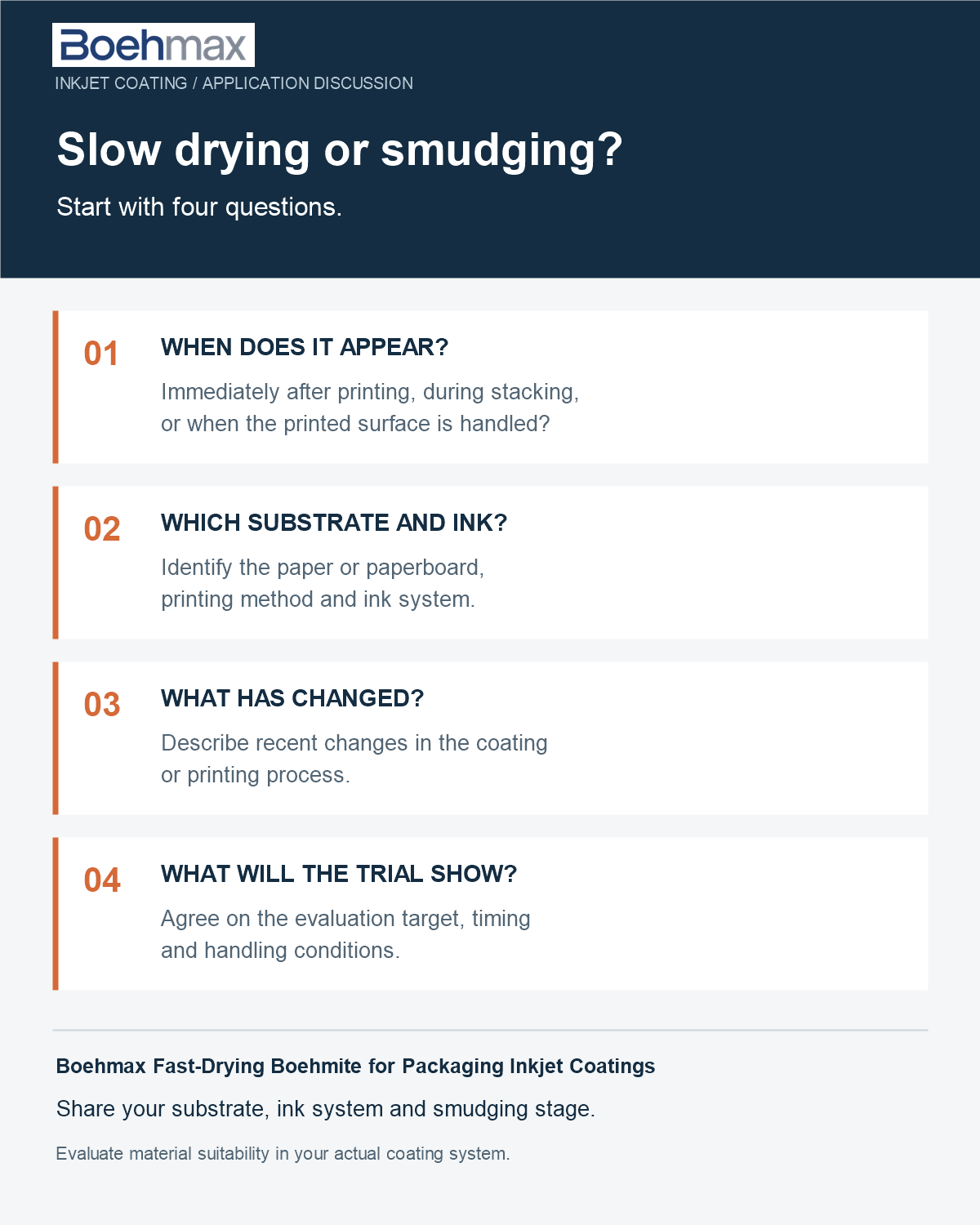
Likewise, a COA covering material properties does not, by itself, confirm finished-media performance. Questions about drying, ink uptake, gloss, or color density still need an appropriate application trial.
Connect the documents to a clear trial objective
The documents become more useful when you know what decision the trial needs to support.
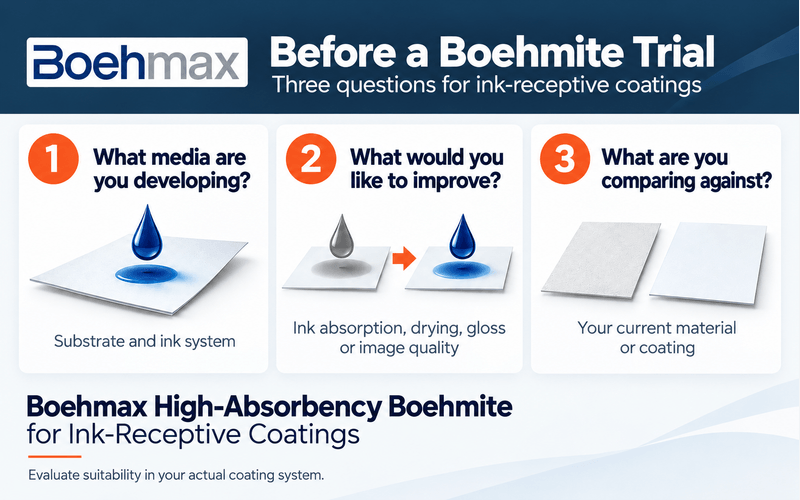
Start with the performance you want to assess and the material or coating you will use as a comparison. Record the relevant trial conditions so that differences in results can be discussed meaningfully.
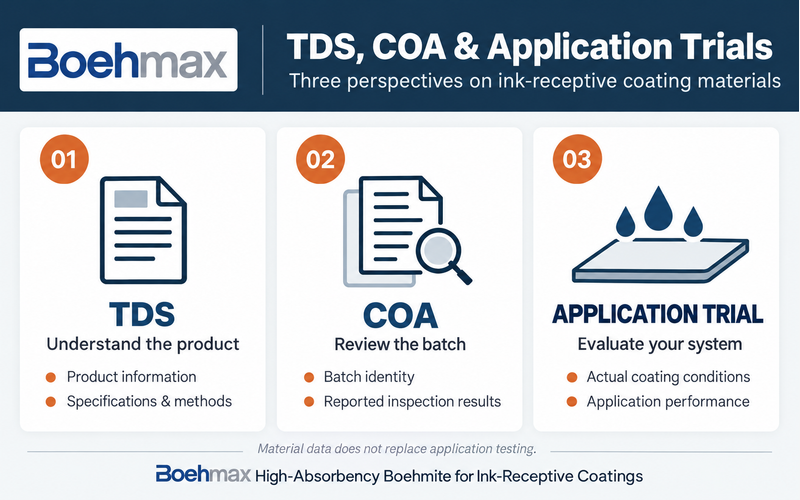
The TDS helps you assess the candidate material. The COA provides the reported information for the identified batch. The application trial shows how that material performs under the conditions you have evaluated.
Together, they support a clearer decision about the next step.
Boehmax High-Absorbency Boehmite for Ink-Receptive Coatings is designed for high-ink-load digital inkjet media and related coating systems. Its suitability for your application should be evaluated under your actual processing and end-use conditions.
What media are you developing, and which performance matters most in your next trial? Share your application with Boehmax to start the discussion.